Bexar County Criminal Defense
The Case Board
Every Bexar County matter starts on one board: the client, the cause number, the court and the judge, the timeline, the conflicts cleared, and the appointed-counsel voucher that pays you for the work.
Inside the app


Where the matter begins
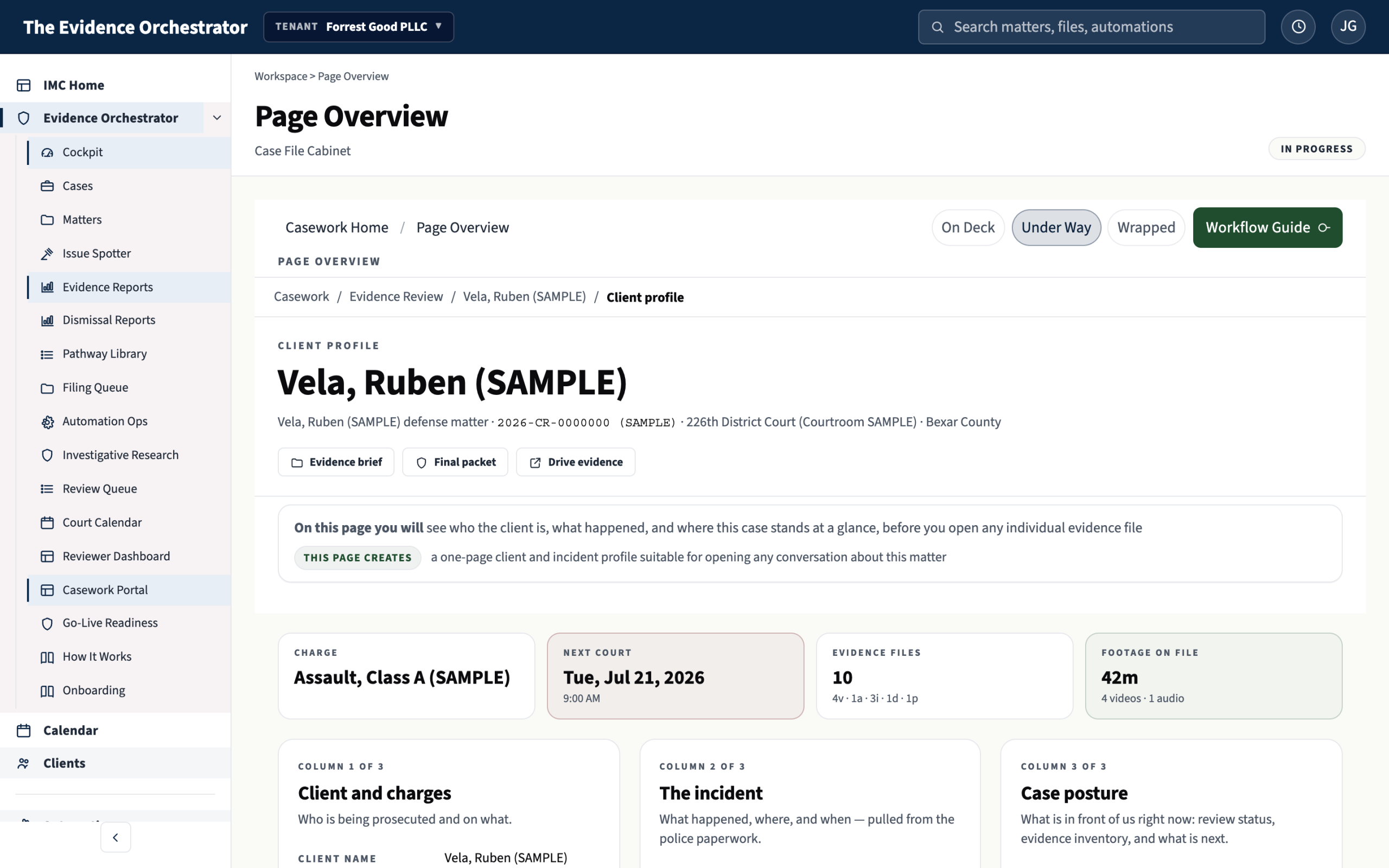
Picture the detective’s board on the wall: the photo, the string, the dates pinned in order, the question that has not been answered yet. That is the Case Board. A new client walks in or a new appointment lands from managed assigned counsel, and the matter opens here first. Client name, cause number, the court down the hall in the Bexar County Courthouse, the judge whose name is on the door, the charge as it is actually charged. Nothing else in the system exists until this board does. The Evidence Orchestrator and the Issue Spotter both reach back to it for every fact they put on paper.
This is the home everything hangs on. Open the matter once, name the people and the numbers once, and the cause number you typed at intake is the cause number that prints on the Article 39.14 discovery demand weeks later. No retyping at midnight before a filing. The board remembers the case the way you would, if you only had one case.
The board reads the appointment email so you do not have to
Here is the part that feels like a trick the first time you see it. A Bexar County appointment notice lands in the inbox, the kind that comes from the county or the Tyler court system, and the matter is standing up before you have opened it. The system reads the defendant identity, the date of birth, the SID and booking number, the cause number, the charge, the court, and the hearing data straight out of that one email. From it the board builds the contact, opens the matter, places the hearing on the calendar when an authoritative date and time are present, and lays out the Google Drive folder tree underneath. You did not assemble any of that. It was assembled, and it is waiting for you to review it.
That is the difference between this board and a folder named after a cause number. The appointment email is treated as the spine of the matter, and everything downstream, the evidence review, the motions, the voucher, hangs off the case it built. The work that used to be an hour of typing before you could even begin is done by the time you sit down.
The matter record is deep on purpose
A criminal matter is not five fields. It is the client and the family member who actually answers the phone, the bond status, the SID and booking number, the charge and the court and the judge, every hearing and every reset, the Drive links, the evidence inventory, the voucher hours. The Case Board carries a matter record with hundreds of fields because the case has hundreds of facts, and a defense that holds all of them is a defense that walks into court whole.
The depth is the point. When the Issue Spotter drafts the Article 39.14 demand, it does not ask you for the cause number again, because the record already holds it. When the voucher comes due, the hours are already there. The board is the single source of truth that sits between the Google Workspace where your files and contacts and calendar already live and the LawPay and QuickBooks where the money already lands. You keep the bookends. The board runs the matter in the middle.
Conflicts cleared before you stand up and announce ready
Before a name goes on the board for good, the board runs the conflict check. Co-defendants, complaining witnesses, prior representation, the people already standing on your other boards. A solo practitioner carries the whole conflicts question alone, with no firm-wide system watching the back wall, and that is exactly when a missed conflict turns into a withdrawal and an awkward call to the court.
The check is advisory, and that word matters. The board checks every new client and matter against everyone already on your boards and tells you plainly: clear, or a name you need to look at. It does not decide the conflict for you, because that is a judgment only a lawyer makes. It makes sure you saw the name before you stood up and announced ready. You decide what it means.
Reset by text, the way court actually moves
Court does not move on a schedule a software form respects. A case gets reset in the hallway, the judge calls it for a new date, and you are already three courtrooms away by the time you could open a laptop. So the board listens for a text. Send a trusted same-day note from your own thread in the shape it expects, a last name and a date, and the new future hearing is created on the matter with the old setting preserved in the history. An out-of-court reset moves the next hearing the same way. When the message is ambiguous, the board says so and opens a task rather than guessing a date onto your calendar, because a guessed court date is worse than no date at all.
This is the board keeping up with the courthouse instead of asking the courthouse to keep up with the board. You reset the case the way you already talk about it, from the hallway, by text, and the record stays whole.
The whole matter in one place
Most defenders run a case across a dozen open tabs: files in one place, the calendar in another, the evidence on a thumb drive, the motions in a folder named final_final. The Case Board is the one place the whole matter lives, sitting between the Google Workspace you already use for files, contacts, calendar, and phone, and the payment and bookkeeping tools that close the loop. The evidence review and the motions both start from this board and write back to it. The Evidence Orchestrator does more than transcribe: it reads the body-camera MP4 itself with Google Gemini and returns an interpretation of the recording, the visual scene, the audio tone of the room, every speaker named as a character, and pins all of it to this board. Every move the system makes is reported back to you in a daily review, so the board shows its work.
Gideon stands at your shoulder here. The promise was never just a lawyer in the room. It was a lawyer with the time and the tools to actually defend the person on the bench. The Case Board is where that lawyer keeps the case, so the appointed client gets the same prepared defense the system was built to require.
Learn
Learn The Case Board
Short, plain reads, step-by-step tutorials, and a self-check on this pillar.
The whole machine
Ten logins down to two
One subscription stands in for the stack a defense firm usually stitches together, so the practice runs on two things it already trusts: Google Workspace, where the files and matters live, and The IMC Machine, where the matter runs. LawPay and QuickBooks, the money rail, stay where they are, fed by the Machine. Casework, evidence, motions, vouchers, marketing, and events, in one place.
San Antonio and Bexar County. The Machine is built for here first. For another city, county, or region, the build-out is custom and carries its own setup fee.
