Bexar County Criminal Defense
The Issue Spotter
A reading of the record into legal pathways for the attorney to weigh, where the motion is drafted, stress-tested, and assembled, and the attorney is the only hand that files.
Inside the app
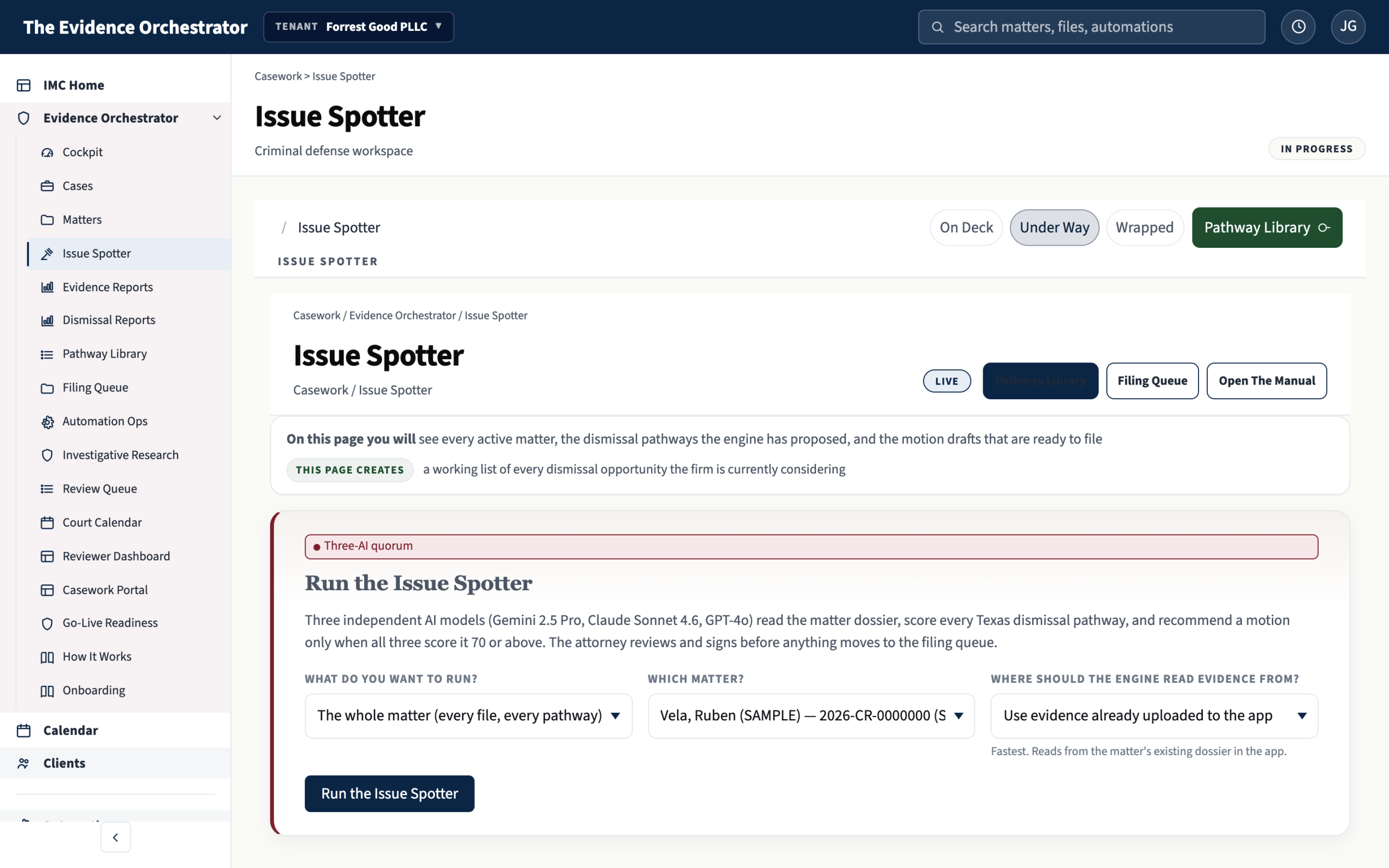

What the Issue Spotter actually is: pathway analysis for counsel to weigh
The Issue Spotter is not a button that ends cases. It is a way of looking at the record the Evidence Orchestrator already read and asking, in structured form, what the law allows you to do with it. The Evidence Orchestrator does more than transcribe: it reads the body-camera MP4 itself with Google Gemini and returns an interpretation of the recording, the visual scene, the audio tone of the room, every speaker named as a character. The hour-by-hour body-cam log, the gap where no warning was given, the cause number and the court already pinned to the matter on the Case Board: the Issue Spotter reads all of that and proposes legal pathways for counsel to consider. A motion to suppress here. An Article 39.14 demand for the report that was never produced. A motion in limine on the photo array.
These are proposals, not conclusions. The Issue Spotter surfaces the pathway and shows its work, the finding in the evidence it is built on and the rule it leans on, so the attorney can see the argument before deciding whether it is one worth making. The lawyer is the one who knows the judge, the client, and the case. The Issue Spotter is the associate who read the whole file overnight and left you a memo.
A charge-level read, with the timestamp that proves it
There is a question that sits underneath an appointed case before any motion: is this really the offense the State charged? Working from the record the Evidence Orchestrator already read, the Issue Spotter returns a charge-level read for the attorney to weigh. Does the body-cam footage support the felony on the charging instrument, or does what actually happened on tape fit a misdemeanor? It names the statute it is reading against and points to the exact second of footage the read is built on, so the attorney is not taking the machine’s word for it but looking at the proof.
This is a read, not a ruling, and it is flagged for the attorney rather than acted on. A felony the evidence does not carry is the difference between a client’s liberty and a plea, and that call belongs to the lawyer. The Issue Spotter’s job is to put the timestamp in front of you and show where the charge and the footage part ways. You decide what to do with it.
The motion writes itself from what the matter already holds
You did the hard part on the Case Board and in the Evidence Orchestrator. The client, the cause number, the court and the judge, the hours, the timestamps where the stop went sideways. When you approve a pathway, the Issue Spotter drafts the motion from that record rather than a blank page at midnight: the canonical Bexar caption a district court expects, the certificate of service built, the signature block carrying the bar number and the address.
What reaches you is a draft that already knows the facts of your case. You read it the way you would read an associate’s first pass, and then you make it sharp. Nothing about that order is automatic. The Issue Spotter proposes and assembles; the attorney decides and signs.
Three AI systems before a human, a human before the court
No single machine gets the last word on a document headed for a Bexar County courtroom. Court-facing documents pass through OpenAI’s ChatGPT, Anthropic’s Claude, and Google’s Gemini, and the Issue Spotter surfaces where they agree and where they diverge on the law, the citations, and the framing. The point is defensibility: a draft checked three ways before a defender’s name goes anywhere near it.
Then it stops, and waits for you. The attorney reads it, edits it, and signs it. Software does not sign a motion and software does not file one.
Honest about the line: assemble today, file by your own hand
Today the Issue Spotter fills the forms and assembles the filing packet, auto-filled from the matter so the client name, cause number, court, and hours land in the right boxes. You file through eFileTexas the way you do now and record the envelope number and filed date back on the Case Board, so the matter stays whole. One-click e-filing straight from the draft is coming soon, and we will say so plainly when it is live. Until then it is not claimed as live. The Issue Spotter writes and assembles. The attorney reviews, signs, and files.
Gideon at the table
Gideon v. Wainwright promised that a person facing the loss of their liberty gets a real lawyer. A real lawyer in 2026 means a lawyer with real tools, not one drafting a suppression motion from memory at the end of a long docket day. The appointed defender and the managed-assigned-counsel attorney carry the same Sixth Amendment weight as any retained lawyer, and the work product should say so. The Issue Spotter exists to put a careful first read of the record and structured drafting tools within reach of every defender, including the appointed lawyer at the end of a long docket, so the appointed client gets a defense built with the same care.
The three-AI quorum
One draft, three readers, one human hand
Every court-facing draft passes through all three of the strongest engines available. The Machine surfaces where they agree and where they part, and the attorney decides. This is a defensibility posture, not an autopilot. Nothing here files itself.
Learn
Learn The Issue Spotter
Short, plain reads, step-by-step tutorials, and a self-check on this pillar.
The whole machine
Ten logins down to two
One subscription stands in for the stack a defense firm usually stitches together, so the practice runs on two things it already trusts: Google Workspace, where the files and matters live, and The IMC Machine, where the matter runs. LawPay and QuickBooks, the money rail, stay where they are, fed by the Machine. Casework, evidence, motions, vouchers, marketing, and events, in one place.
San Antonio and Bexar County. The Machine is built for here first. For another city, county, or region, the build-out is custom and carries its own setup fee.
