Bexar County Criminal Defense
How the Case Board builds a matter
Follow one Bexar County appointment from the email that opens it to the calendar that keeps it, step by step, and see exactly where the lawyer’s hand goes on the record.
Inside the app

1. The appointment email lands, and the board reads it
It starts with an email. A Bexar County appointment notice arrives, the kind sent by the county or the Tyler court system, and a watcher recognizes it for what it is. It reads the facts straight out of the message: the defendant identity, the date of birth, the SID and booking number, the cause number, the charge, the court, and the hearing data. Nothing is typed. The email is the spine of the matter, and the board treats it that way.
This is the moment the case becomes a case. Before this email, there is a person in custody and a notice in an inbox. After it, there is a matter on a board with a name, a number, and a court, ready for a lawyer to look at.
2. The contact and the matter open themselves
From what the email holds, the board creates or reuses the contact and opens the matter. If the client already exists on another of your boards, the board reuses that contact rather than spawning a duplicate, so one person with three cases is one person with three matters, not three half-built strangers. The matter record fills with the charge, the court, the judge, and the hearing data the email carried.
You did not open six windows to do this. You did not retype a client name into a sixth form. The matter is standing up, and the first thing you do is review what was built, not build it.
3. The Google Drive folder tree gets laid down underneath
With the matter open, the board builds the folder tree in your Google Drive: the client folder, then the matter folder beneath it, then the standard subfolders for evidence and casework. Then it writes the Drive links and folder IDs back onto the matter, so the board and the Drive point at each other and neither one drifts. The folder spec is preserve-first: it never overwrites what is already there, and it separates folders by exact cause number, so a client with multiple matters gets clean, non-colliding folders instead of one drawer everything falls into.
This is where the discovery will land. When the Evidence Orchestrator downloads the body-cam video and the audio and the photographs, it places them in this exact folder, because the matter built the container before the evidence arrived.
4. Privilege-tiered storage keeps the file in its lane
Not every document in a matter sits at the same level of protection, and the folder tree knows it. Work product, client communications, and the raw discovery do not belong in the same undifferentiated pile. The subfolder structure is built so that the privileged casework and the evidence each have their own place, and the matter is always the container while the sender is only metadata. Different people emailing about one case never spawn separate top-level folders, because the case is the drawer and the correspondents are just labels inside it.
The point is a file you can defend the handling of. When a judge or the State asks what is in the file and how it was kept, the answer is a structure, not a shrug.
5. The court calendar builds from the clerk’s own feeds
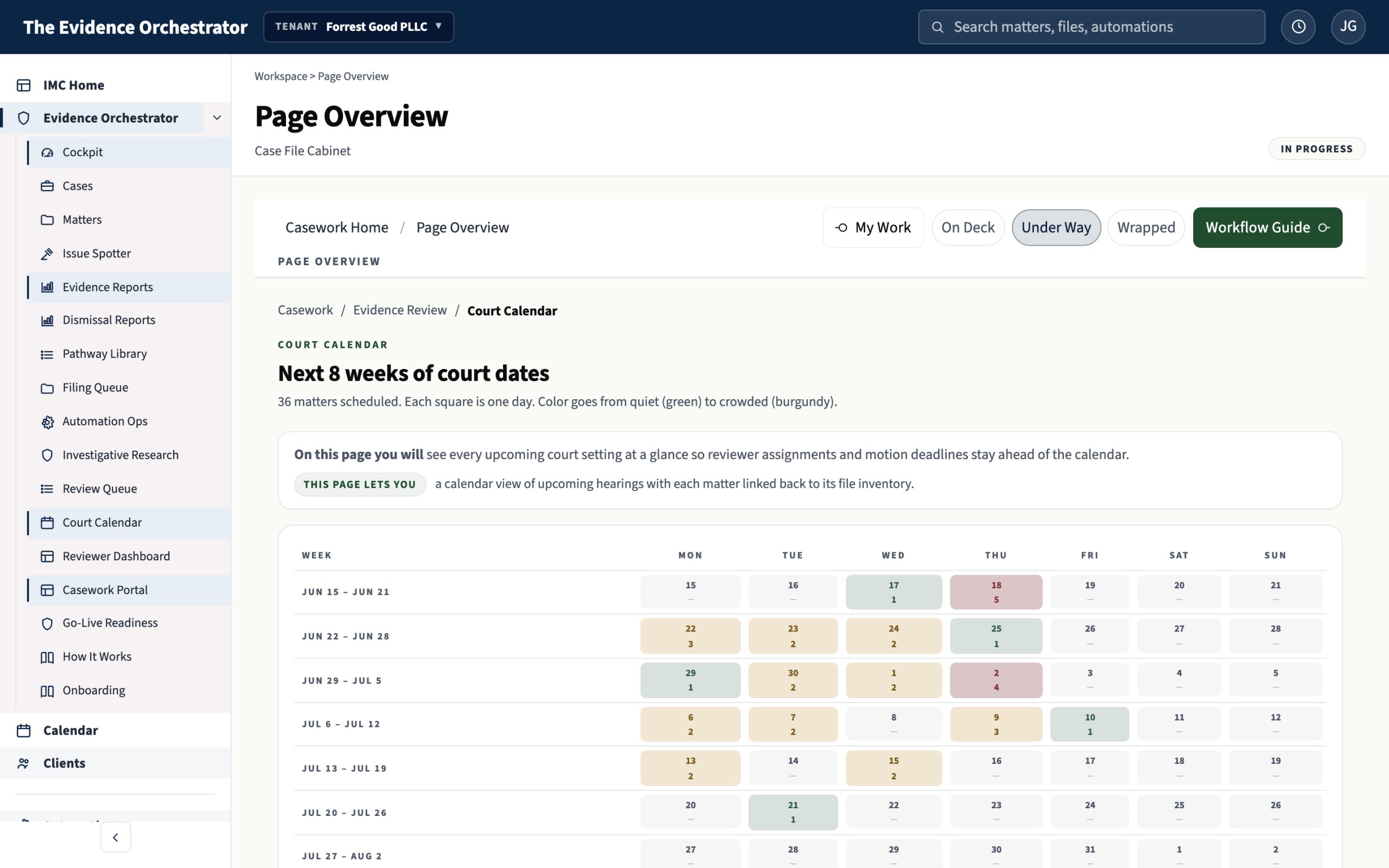
A criminal matter is a sequence of dates, and missing one is how good lawyers get hurt. So the calendar does not depend on you copying dates off a notice. The board reads the court’s own email: the case-specific settings, the Zoom docket invitations with the meeting ID and passcode, the jail-court hearings, the coordinator notices that speak in relative dates. From each it writes one trustworthy hearing onto the matter, resolving relative language against the date the email was received.
It prefers truth over speed. When a date is authoritative, the hearing goes on the calendar. When a docket is generic or a setting is ambiguous, the board opens a review task instead of guessing an event onto your week. Once a day it audits the matters and the synced calendar against the county’s own portal for your bar number and flags anything missing or changed, and it cleans up clear duplicates rather than letting two of the same hearing sit on the same day.
6. Reset by text, advisory conflicts, and the hand that signs
Two more things make the board move the way the courthouse moves. The first is reset by text. When a case is reset in the hallway, you send a trusted same-day note from your own thread, a last name and a date, and the board creates the new future hearing while preserving the old setting in the history. An out-of-court reset moves the next hearing the same way. When the message is ambiguous, the board reports the ambiguity rather than dropping a guessed date on your calendar.
The second is the conflict check, and it is advisory by design. Before a new client settles onto the board, the system checks the name against everyone already on your matters and tells you plainly: clear, or a name to look at. It surfaces the conflict. You decide what it means, because that judgment belongs to a lawyer and not to a machine. That is the rule the whole board runs on. The system reads the email, builds the matter, lays the folders, keeps the calendar, and tracks the voucher hours, and then it stops at the line where a lawyer has to think. Nothing files, nothing sends, and nothing leaves the building without your hand on it. That is what makes the board safe to trust with the case Gideon promised you would defend.
The whole machine
Ten logins down to two
One subscription stands in for the stack a defense firm usually stitches together, so the practice runs on two things it already trusts: Google Workspace, where the files and matters live, and The IMC Machine, where the matter runs. LawPay and QuickBooks, the money rail, stay where they are, fed by the Machine. Casework, evidence, motions, vouchers, marketing, and events, in one place.
San Antonio and Bexar County. The Machine is built for here first. For another city, county, or region, the build-out is custom and carries its own setup fee.
